COSMOS
Cloud Enhanced Open Software-Defined Mobile Wireless Testbed

Platform Now in General Availability for Research
COSMOS is partnering with New York City, Silicon Harlem, City College of New York, University of Arizona and IBM, to bring this advanced wireless testbed to life in New York City. The testbed will cover 1 square mile in a vibrant, densely-populated neighborhood in West Harlem. The technical focus of the COSMOS platform is on ultra-high-bandwidth and low-latency wireless communications, with tightly coupled edge computing, a type of cloud computing enabling data processing at the edge of the network. COSMOS will pursue millimeter-wave radio communications and dynamic optical switching technologies. This new wireless research platform will allow for experimentation at a scale that could not be achieved previously, thereby enabling new services and applications to benefit the entire community.
COSMOS INTERACTIVE COVERAGE AREA MAP
Click radio icons on map for details, and layer icon at top right for options
COSMOS: Cloud Enhanced Open Software-Defined Mobile Wireless Testbed for City-Scale Deployment, Rutgers University, Columbia University, New York University
Click here to visit the COSMOS website.
Click here to watch a video summary of COSMOS.
COSMOS is part of the National Science Foundation’s PAWR program, and is funded in part by NSF award CNS-1827923, and by the PAWR Industry Consortium.
NETWORK RESOURCES
View the architecture diagram here.
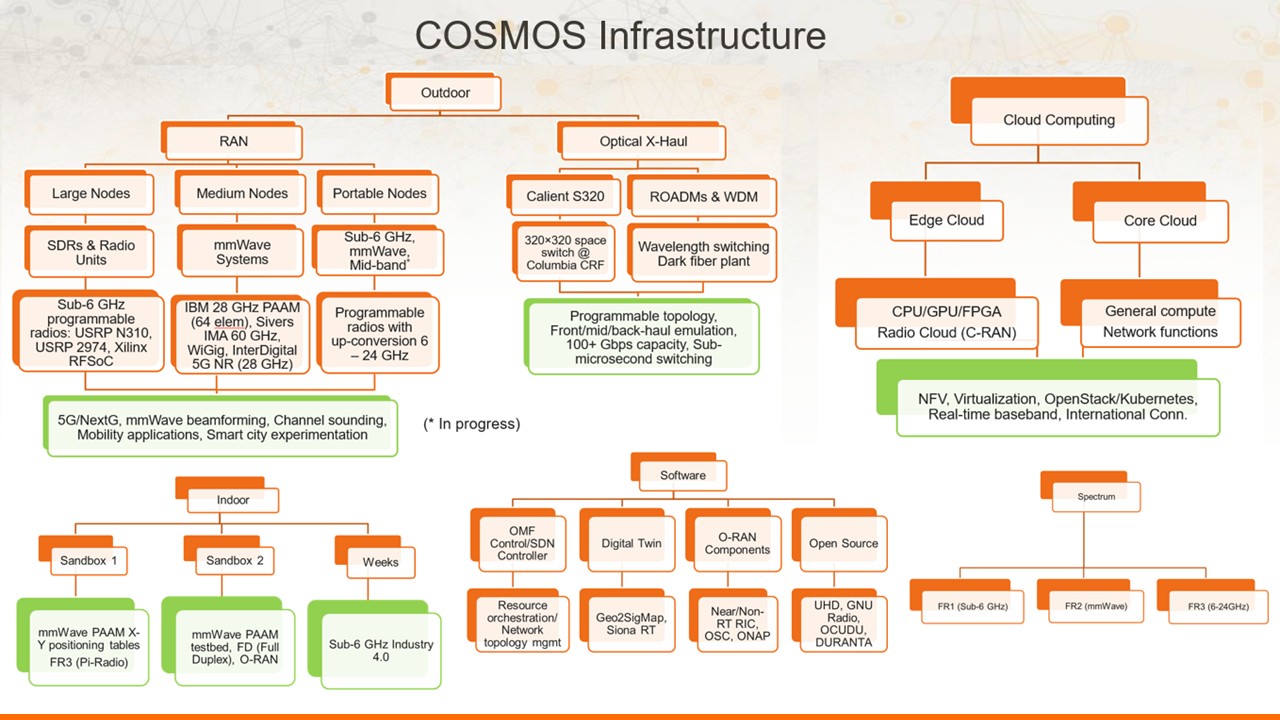
Click to enlarge
SAMPLE AVENUES OF RESEARCH
Millimeter-Wave Communications & Adaptive Beamforming
COSMOS provides an outdoor mmWave testbed in the streets of West Harlem, with radios operating at 28 GHz and 60 GHz, enabling researchers to collect real-world propagation data and validate link performance in a live urban environment. Unlike controlled indoor settings, researchers can explore massive MIMO, adaptive beamforming, antenna array optimization, and high-frequency propagation characteristics in dense urban settings. These experiments help advance understanding of how to achieve reliable, directional connectivity in real environments and how high-frequency signals behave in a city canyon full of buildings, people, and vehicles.
Optical-Wireless and Dynamic Switching
COSMOS features a programmable optical x-haul network built on dark fiber, with software-defined switching that allows researchers to define and reconfigure network topologies on the fly. Paired with the testbed’s edge cloud computing nodes, this setup enables research into how radio access and optical networking can be jointly optimized and to test dynamic optical switching, where the optical backhaul is treated as an active, controllable component rather than fixed infrastructure, ensuring the back-end of the network doesn’t become a bottleneck to perform end-to-end experimentation that bridges radio access and core networking in a live city environment.
Ultra-High-Bandwidth Low-Latency and Edge Computing
By tightly coupling wireless nodes with edge cloud computing resources in a dense urban neighborhood, researchers gain a real-world environment that delivers gigabit-level data rates, millisecond-scale latency, and adaptive networking to support immersive applications such as augmented reality (AR), virtual reality (VR), and real-time cloud gaming. Researchers can run these experiments with actual users and traffic to develop and test applications that require near-instantaneous response times.
Dynamic Spectrum Access
Researchers can test and compare different dynamic spectrum access approaches, from cooperative to non-cooperative strategies and from centralized to fully distributed architectures, to examine how competing users coordinate and manage spectrum reuse, and to measure the impact on network performance as spectrum policies change. This includes evaluating how next-generation systems detect, share, and adapt to spectrum use in real time, as well as collecting wireless data to inform models that sense interference and architect optimal spectrum access.
SELECT PUBLICATIONS
Check out a list of publications citing COSMOS here.