Designing and Testing FSOC Systems on the AraOptical Testbed
Because of the physical and costly limitations of deploying fiber-optic networks and the ever-increasing demand for 5G/6G capabilities, free-space optical communication (FSOC) has emerged as a critical enabler for next-generation high-speed communication systems. FSOC transmits optical signals directly through the atmosphere without the need for a physical medium, such as fiber, enabling flexible and cost-effective deployment in urban, rural, aerial, and satellite networks.
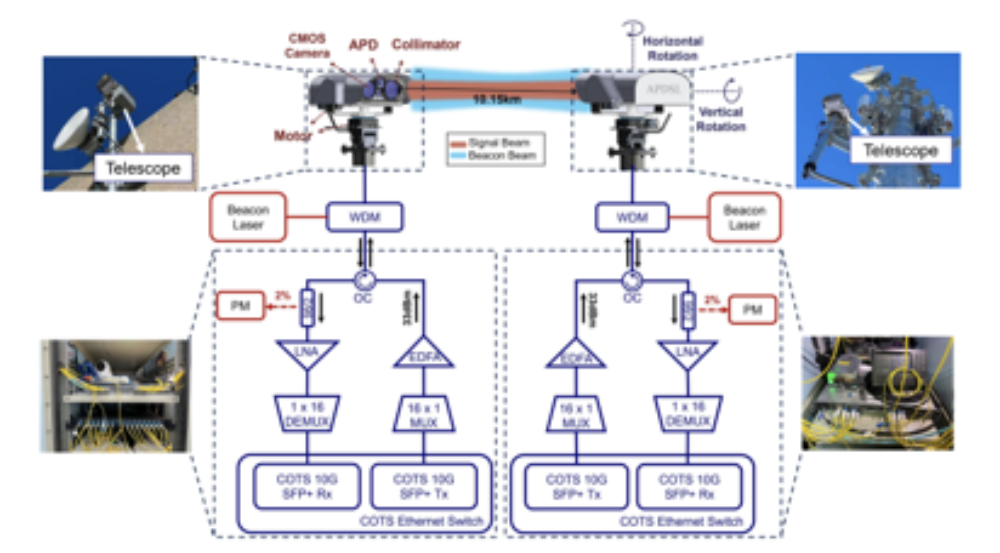
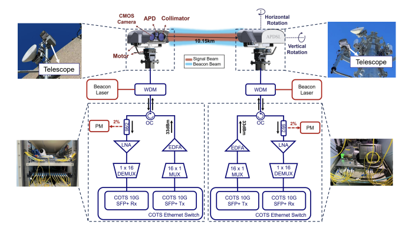
Researchers at the University of California, Irvine, and Iowa State University built and integrated AraOptical, an FSOC system, into the ARA wireless living lab in rural Iowa. The experiment uses commercially available switches and transceivers to provide a practical baseline for network performance.
Researchers successfully maintained a 6.3-mile optical link using commercial equipment and sustained alignment in real-world atmospheric conditions to maximize the received signal. In addition, they showed that weather variables, such as temperature, pressure, and humidity, can help predict network performance.
Why It Matters
This experiment demonstrates the feasibility of using in-situ environmental sensing and data-driven models to characterize and predict FSOC performance under real-world conditions. This approach may lead to fully autonomous optical wireless backhaul systems and enhance the long-term robustness of next-generation FSOC infrastructures.
The integration of AraOptical into the ARA platform will further enable research and development of optical wireless technologies, which can potentially extend connectivity in rural environments where physically extending fiber is impractical.
Learn more about the ARA platform and read the paper here.
About ARA
ARA is part of the National Science Foundation’s PAWR program, and is funded in part by NSF, the U.S. Department of Agriculture’s National Institute of Food and Agriculture (NIFA), and by the PAWR Industry Consortium.