COSMOS Intelligent Vehicular Surface for Reliable mmWave Handover
Welcome to Wall-Street
5G wireless networks leverage millimeter wave (mmWave) spectrum in the FR2 band to deliver multi-gigabit, low-latency connectivity. These networks face significant challenges in maintaining reliable connections for users moving at high speeds, particularly in vehicles. Frequent handovers, complex beam alignment, and signal blockage from car bodies can lead to connection time-outs and degraded performance for in-vehicle mobile users.
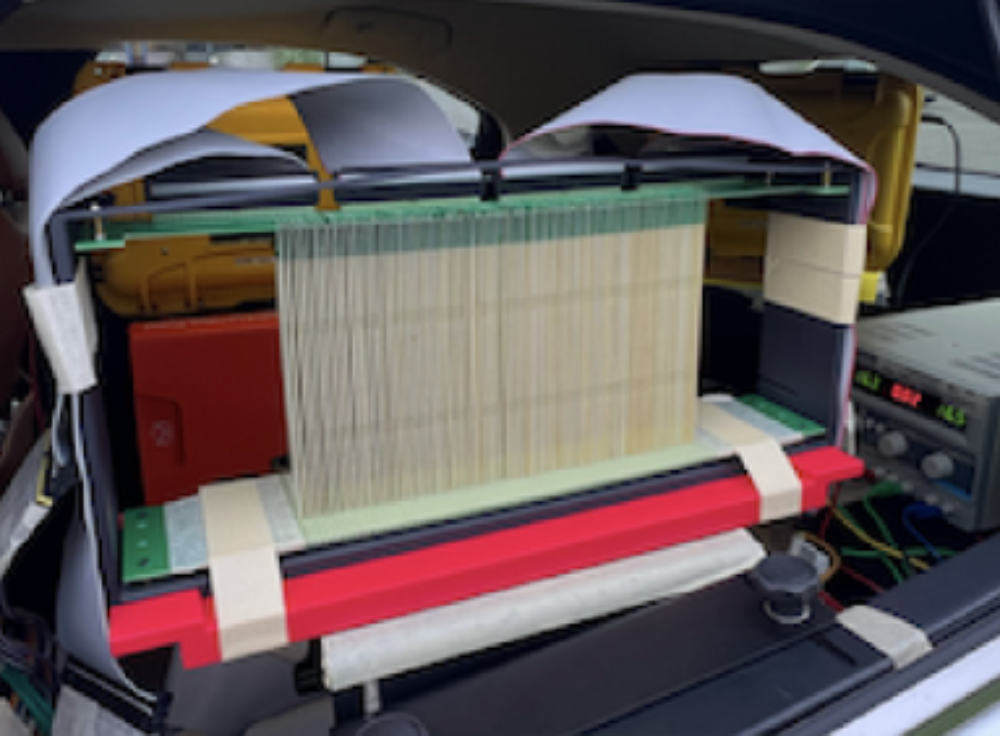
To enhance mmWave connectivity, researchers designed, implemented, and integrated Wall-Street, a vehicle-mounted smart surface, into the COSMOS wireless testbed.
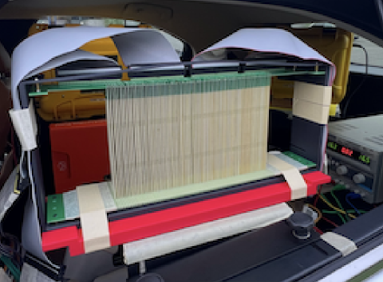
Wall-Street enhances mobile network management by:
- Steering outdoor mmWave signals into the vehicle for shared coverage and providing a single, collective handover for all users
- Performing neighbor-cell search without interrupting data transfer, ensuring seamless handovers with concurrent communication
- This is done by uniquely steering two mmWave beams simultaneously in transmissive and reflective angles
- Connecting users to a new cell before disconnecting from the old cell for reliable cell transitions, known as a make-before-break handover
Why it Matters
- Through Wall-Street’s integration with the COSMOS testbed, researchers demonstrated a scalable, vehicle-centric handover solution for reducing network latency, improving throughput, and providing more reliable connections for multiple passengers in high mobility situations.
- Under outdoor multiuser settings, Wall-Street demonstrated improved throughput by up to 78% and reduced delay by up to 34%.
- The experiment opens possibilities for public transportation connectivity, connected vehicles, smart city technologies, and further research.
Read more about the Wall-Street experiment in the published paper.
Authors: Kun Woo Cho (Princeton University and Rice University), Prasanthi Maddala (Rutgers University), Ivan Seskar (Rutgers University)
About COSMOS
COSMOS is part of the National Science Foundation’s PAWR program and is funded in part by NSF and by the PAWR Industry Consortium.