Research on ARA Demonstrates High-Performance Distributed Edge Computing over Rural 5G
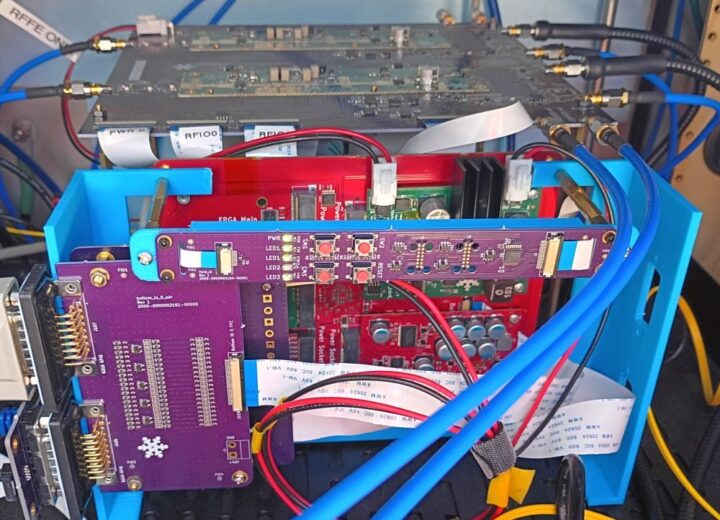
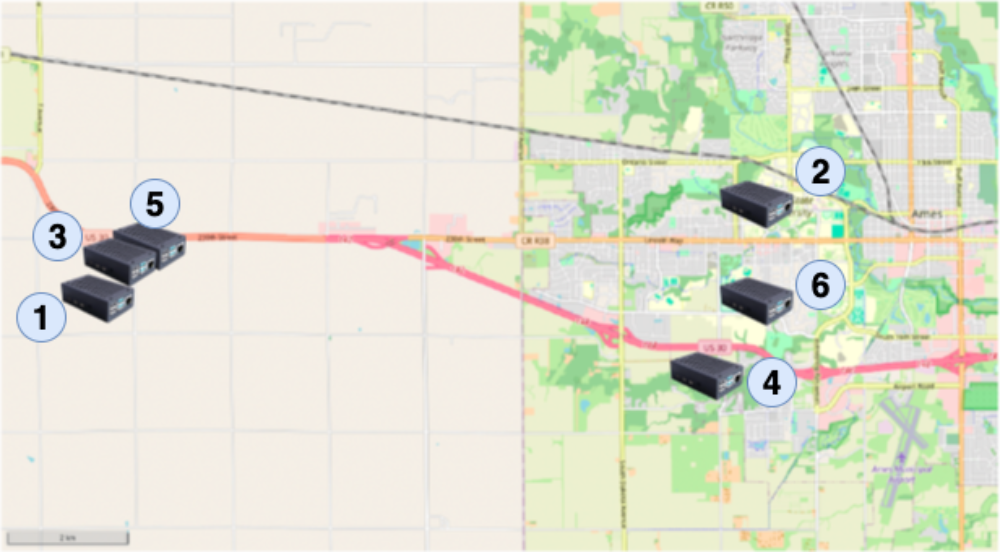
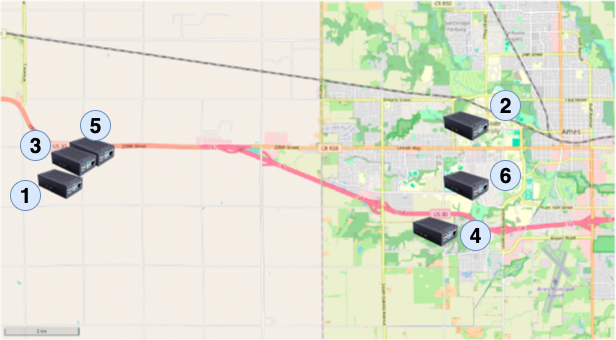
In an experiment that leveraged ARA’s bring-your-own-device model, researchers from the University of Missouri, as part of the REU Summer Research Program at the University of Chicago, deployed six Raspberry Pi 4 devices on the rural Iowa testbed to measure wireless performance for distributed computing applications. The results demonstrate the ability of rural 5G infrastructure to support edge computing applications – including precision agriculture, rural sensing, and resilient field infrastructure – even on resource-constrained devices in a sparse network environment.
The Experiment
The research team connected six Raspberry PI devices using millimeter wave (mmWave) links powered by Ericsson radios and various forms of backhaul infrastructure across a geographic footprint with a six-mile radius. The devices were programmed to self-organize to perform distributed computational tasks, creating a functional prototype of a wireless edge computing cluster. The research determined that:
- 5G connections performed on par with wired ones for small-to-moderate workloads, with throughput reaching more than 70 Mbps at its peak.
- As the number of nodes increased, performance per node slightly decreased due to synchronization requirements.
- mmWave 5G links supported scalable, coordinated computation with minimal coordination delay. The research team used GPS-based measurements and recorded sub-millisecond latency when devices had a clear line of sight to 5G radios.
Why it Matters
By leveraging ARA’s BYOD capabilities and unique outdoor infrastructure – including commercial-grade Ericsson radios – researchers were able to plug their own devices into a rural wireless network and iterate on an experiment under real-world conditions. This approach and its results illustrate the value of accessible, field-driven experimentation that goes beyond traditional lab settings.
Authors: Zack Murry (University of Missouri), Alicia Esquivel Morel (University of Missouri), and Kate Keahey (Argonne National Laboratory)
About ARA
ARA is part of the National Science Foundation’s PAWR program, and is funded in part by NSF, the U.S. Department of Agriculture’s National Institute of Food and Agriculture (NIFA), and by the PAWR Industry Consortium.