Using ARA to Evaluate the Effectiveness of Liquid Data Transport over the OneWeb LEO Satellite Network
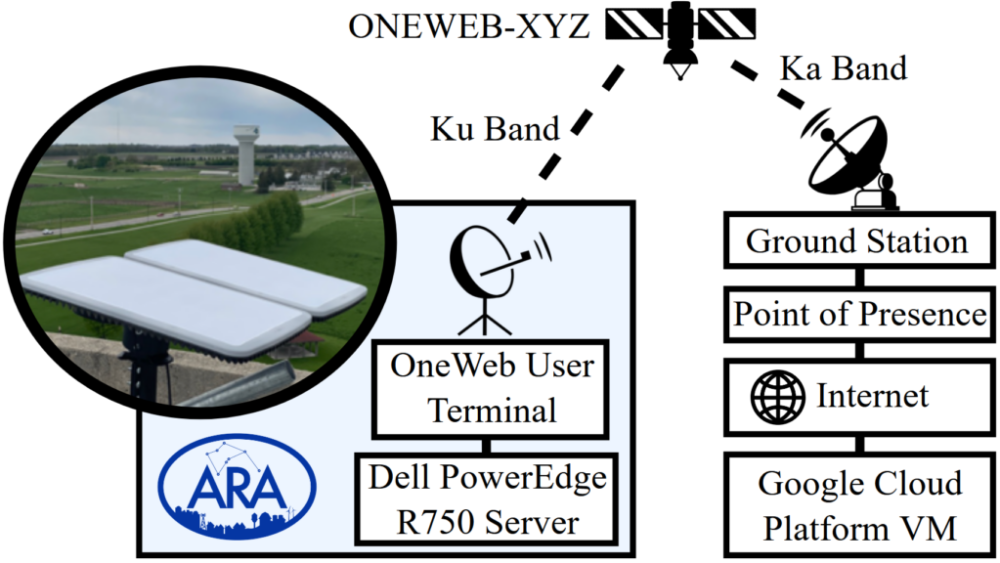
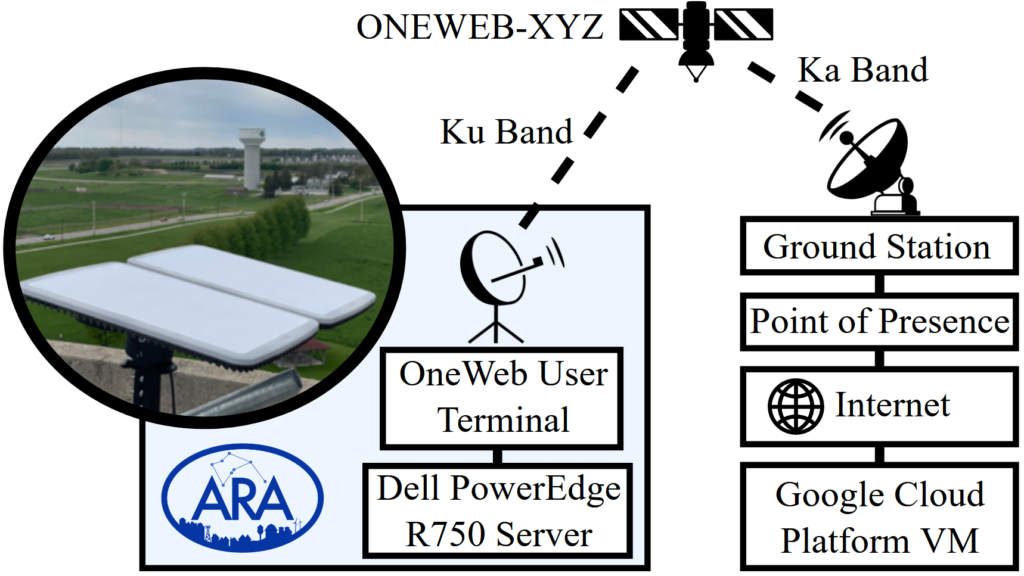
Even with newer low Earth orbit (LEO) networks such as SpaceX’s Starlink and Eutelsat’s OneWeb, satellite internet can still face reliability challenges. Data packet loss as low as 1–2% can quietly strangle performance, triggering constant retransmissions that pile up and drag throughput down. Such loss can adversely affect use cases where maintaining continuous data flow is critical, such as live video streaming and voice communications. The ARA team explored these challenges by testing liquid data transport over a OneWeb connection at Iowa State University, running experiments between Ames and a Google Cloud server in Virginia.
Liquid data is a combination of source and repair symbols that ensures reliable data delivery. Liquid data transport relies on RaptorQ forward error correction (FEC), a type of fountain code that encodes source data into a stream of symbols. The receiver does not require per-symbol acknowledgements and can rebuild the code regardless of arrival order. Instead of depending on repeated retransmissions, the system continuously sends coded data that can be reconstructed at the receiver, enabling applications to run with far fewer interruptions.
In the experiment, under a 1% loss rate, standard TCP with CUBIC congestion control barely functioned, while liquid data maintained a steady 10 Mbps throughput and reduced retransmissions from more than 1,700 to just 81. The result is a shift from a jittery, unpredictable connection to a stable, consistent flow, ensuring that even as satellites constantly move overhead, data doesn’t skip a beat – pointing to a more resilient future for satellite connectivity.
Why It Matters
- By repairing data streams in real time, rather than depending on TCP’s retransmission cycles, liquid data allows congestion control algorithms to operate more effectively.
- This experimental approach reflects ARA’s broader vision of building a “living lab” for wireless innovation, where new ideas can be tested and scaled for rural communities and data-intensive applications.
Learn more about the Liquid Wireless Transport Layer (LiqTL) and its performance in the ARA team’s paper, “A Measurement Study of Dynamics and Liquid Data Transport in OneWeb LEO Satellite Networks.”
About ARA
ARA is part of the National Science Foundation’s PAWR program, and is funded in part by NSF, the U.S. Department of Agriculture’s National Institute of Food and Agriculture (NIFA), and by the PAWR Industry Consortium.